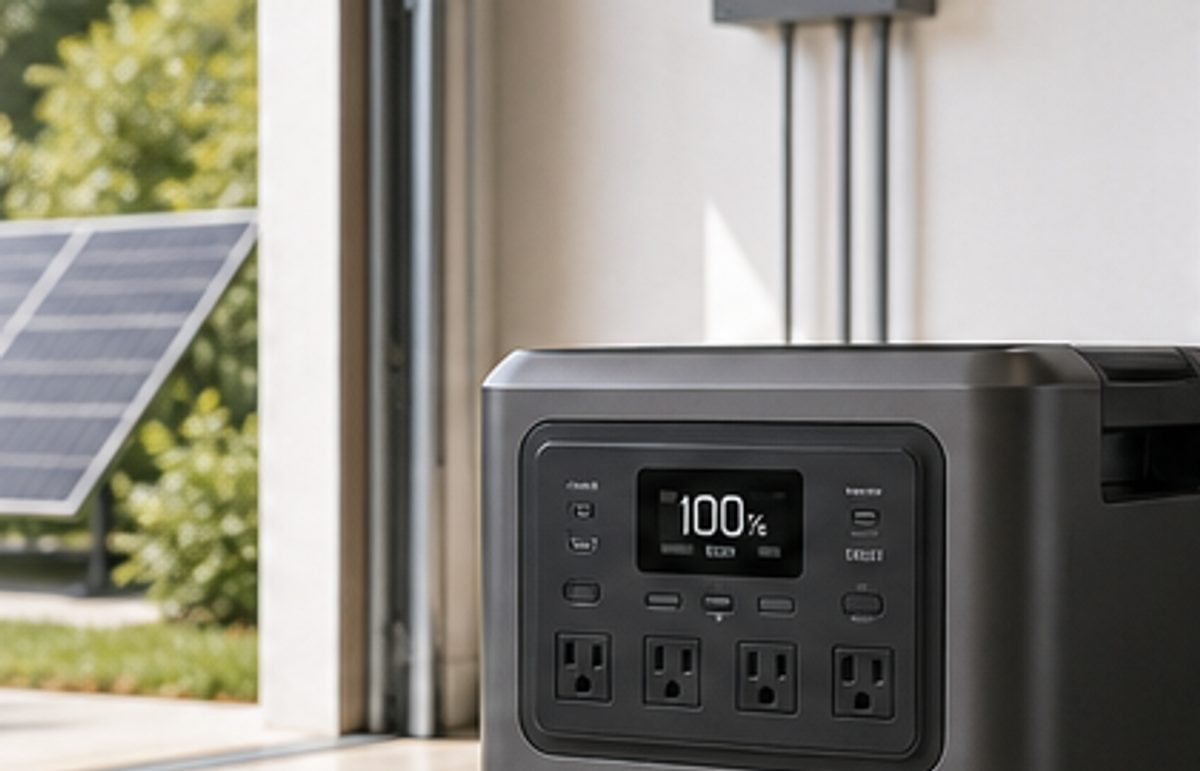
Pairing solar panels with your power station
Check voltage, current, power, polarity and connector before you connect panels, then size panel watts for Canadian sunshine with stated assumptions.

How this guide was built
Prices come from Canadian portable power and home backup retailers and are refreshed on a regular schedule. The price at the retailer is the one that counts, so confirm it before you buy.
The kits and picks in a guide are chosen by our team to match its examples, not paid placements. Specifications come from manufacturers, so check the current manual before you buy.
Solar input turns a power station from a big battery into a system you can recharge, but panels and stations only work together inside hard electrical limits, and real charging is slower than the sticker numbers suggest. This guide gives the compatibility checks first, then the sizing math with its assumptions stated.
The compatibility checklist
Check all five against your power station's manual and your panel's datasheet before you connect anything.
- Voltage. The array's open-circuit voltage (Voc) must stay below the station's maximum input voltage at the coldest temperature you will use it, and the array's operating voltage must sit inside the station's input window.
- Current. The array's short-circuit current (Isc), summed across parallel strings, must stay within the station's maximum input current.
- Power. Compare the array's rated watts with the station's maximum input watts. Exceeding it is a matter of what the manual says happens (see overpanelling below); exceeding the voltage or current limit can damage hardware.
- Polarity. Positive to positive, negative to negative, through the right adapter.
- Connector. Most panels use MC4 connectors; many stations use a brand-specific port (often XT60) with an MC4 adapter cable included or sold separately. Confirm the cable before buying third-party panels.
Wiring rule of thumb: series adds voltage, parallel adds current. Combine only identical panels in one array.
Voltage: why Canadian winters matter
A panel produces its highest voltage with nothing drawing current. That open-circuit voltage rises as the cell gets colder. Every module datasheet lists a temperature coefficient of Voc, typically a few tenths of a percent per degree Celsius for crystalline silicon panels (about −0.3 %/°C is a common figure; use the one on your datasheet). The cold-weather voltage is:
Voc at the coldest temperature = Voc at 25°C × (1 + coefficient × (coldest temperature − 25))
With a −0.30 %/°C coefficient, at −20°C that is Voc × (1 + 0.003 × 45) = Voc × 1.135. Your own limit is not a fixed 85% or 90%: it is whatever keeps that cold voltage below the station's maximum input voltage, using the coefficient on your datasheet and the coldest temperature you actually expect. Panels also carry a small tolerance, so leave room rather than sitting exactly on the limit.
A worked match, step by step
These specifications are illustrative, not a real product. Use your own.
| Item | Illustrative value |
|---|---|
| Station: maximum input power | 500 W |
| Station: input voltage window | 11 to 48 V |
| Station: maximum input current | 12 A |
| Panel: rated power | 100 W |
| Panel: Voc and Isc | 22.5 V and 6.0 A |
| Panel: Voc temperature coefficient | −0.30 %/°C |
Two panels in series (voltage adds): Voc is 45.0 V at 25°C, but at −20°C it is 45.0 × 1.135 = 51.1 V, above the 48 V limit. This pairing is unsafe in a Canadian winter, even though it looks fine in July.
Two panels in parallel (current adds): Voc stays 22.5 V (25.5 V at −20°C), well inside the window. Isc is 2 × 6.0 = 12.0 A, exactly the station's limit, which leaves no margin. Check what the manual says about current at the limit before relying on it, or use one panel per input if the station has more than one.
Power is the easy part: 2 × 100 W = 200 W is below the 500 W limit.
Overpanelling and manufacturer limits
Connecting more panel watts than the station's maximum input is sometimes done to improve charging in weak light, but whether it is allowed is the manufacturer's call. Some stations simply limit the power they draw; others state a maximum array size or warn against exceeding it. Follow the manual, and never exceed the voltage or current limits regardless of watts.
Portable folding versus rigid panels
Portable folding panels (commonly 100 to 400 W each) are what brands sell alongside power stations: light, quick to set up, easy to angle, storable indoors. They cost more per watt than rigid panels, and fabric-backed folding panels are generally not designed to live outdoors permanently.
Rigid glass panels, the kind used on roofs, usually cost less per watt and are built for years outdoors. They are heavy and suit a fixed installation: a cabin roof, a shed, a ground mount. With an MC4 adapter and the checks above, many stations accept them. A reasonable split: folding panels for camping and occasional backup, rigid panels for anything that stays put.
How much a panel really delivers
A "200 W" panel is rated under standard test conditions: perpendicular sunlight at a fixed intensity and a 25°C cell. Outdoors you lose output to sun angle, haze, heat, dust and shade. Natural Resources Canada's photovoltaic potential model applies a performance ratio of 0.75 to estimate real output, and describes well-functioning systems as typically between 0.75 and 0.9 in their early years (NRCan). This guide plans with 0.7, a little lower, to cover portable panels laid flat or partly shaded and the losses between panel and battery. Treat it as a planning assumption, not a promise.
How much sun: peak sun hours by season
Panel sizing uses peak sun hours: the day's solar energy expressed as hours of full-strength sun. The figures below are monthly climatology for a horizontal surface, averaged over 2001 to 2025, from NASA's POWER project (NASA POWER). A panel tilted toward the south collects more than a flat one in winter, by an amount that depends on tilt and location, and snow cover or shading can take it all back, so use these as a conservative starting point.
| City | Summer (May to August) | Spring and fall (March, April, September, October) | Winter (November to February) | December |
|---|---|---|---|---|
| Calgary | 5.7 | 3.5 | 1.4 | 0.9 |
| Winnipeg | 5.7 | 3.7 | 1.7 | 1.0 |
| Toronto | 5.7 | 3.6 | 1.6 | 1.2 |
| Halifax | 5.3 | 3.7 | 1.6 | 1.1 |
| Vancouver | 5.5 | 3.0 | 1.1 | 0.7 |
The takeaway: a panel array that comfortably recharges your station in July can produce a quarter of that in winter, and December is lower still. If winter outages are your use case, size for winter, or treat solar as a top-up. NRCan publishes monthly and annual photovoltaic potential for more than 3,500 Canadian municipalities if you want your own location's figures.
Cold also affects the battery side: standard lithium-ion cells should not be charged below freezing, because charging a frozen cell can permanently damage it (Battery University). Winter solar charging therefore needs a station that is designed to heat or block charging, or a station kept indoors with cables run outside. See the buying guide.
Sizing panels to recharge a daily need
Panel watts needed = daily Wh the panels must put into the battery ÷ (peak sun hours × 0.7)
If your load runs through the inverter, first divide the AC energy by 0.85 to get the battery-side energy (the same conversion assumption as the sizing guide). Examples for Toronto, using the table above:
| Daily need | Summer, 5.7 hours | Spring and fall, 3.6 hours | Winter, 1.6 hours | December, 1.2 hours |
|---|---|---|---|---|
| 500 Wh into the battery (a weekend of small loads) | about 125 W | about 200 W | about 450 W | about 600 W |
| 2,376 Wh into the battery (the sizing guide's "essentials" load, 2,020 Wh of AC ÷ 0.85) | about 600 W | about 940 W | about 2,120 W | about 2,830 W |
The last row is the honest one: meaningful winter solar in Canada takes a lot of panel, often more than a mid-size station will accept. Compute your own daily Wh with the home backup sizing guide before assuming a single folding panel will keep you topped up.
Bundles versus buying separately
Brands often price station and panel bundles together, and a bundle comes with electrical compatibility and the right cables. Buying separately is worth it when you want rigid panels, already own panels, or find a third-party panel you prefer. The going-third-party checklist is the one at the top: voltage with cold margin, current within the limit, power, polarity, and the adapter in hand.
Panels and kits that match
Best options · priced live
Solar pairing picks
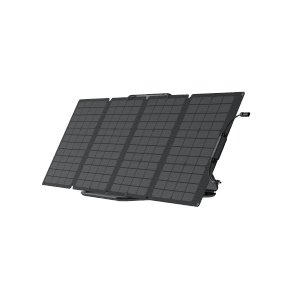
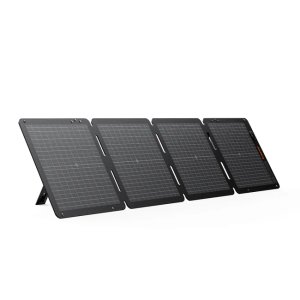
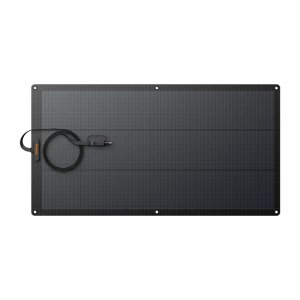
Choose one. Prices are per option.
Sources and notes
- Photovoltaic performance ratio and monthly and annual potential: Natural Resources Canada, Photovoltaic potential and solar resource maps of Canada. NRCan notes its monthly values are indicative and do not account for temperature, snow or year-to-year variation.
- Peak sun hours: NASA POWER climatology (All Sky Surface Shortwave Downward Irradiance, horizontal surface, 2001 to 2025), averaged by the season groups shown. City coordinates are approximate city-centre points.
- Voc temperature coefficient: use the figure on your panel's datasheet. The −0.3 %/°C figure here is illustrative.
- Cold-charging limit: Battery University, Charging at high and low temperatures.
- The 0.7 planning factor and the illustrative station and panel in the worked match are this guide's assumptions, stated above.
See a deal you like? Set a target price.
We'll watch it at Canadian power retailers and email you when it drops.
Track a price on any product
Explore More Guides
Shop Related Deals
Get notified about new guides
We publish guides on choosing a power station, sizing home backup, and pairing solar panels. Subscribe to be told when one is added. No spam, unsubscribe anytime.
Sent by powerstations.ca · powerstations.ca