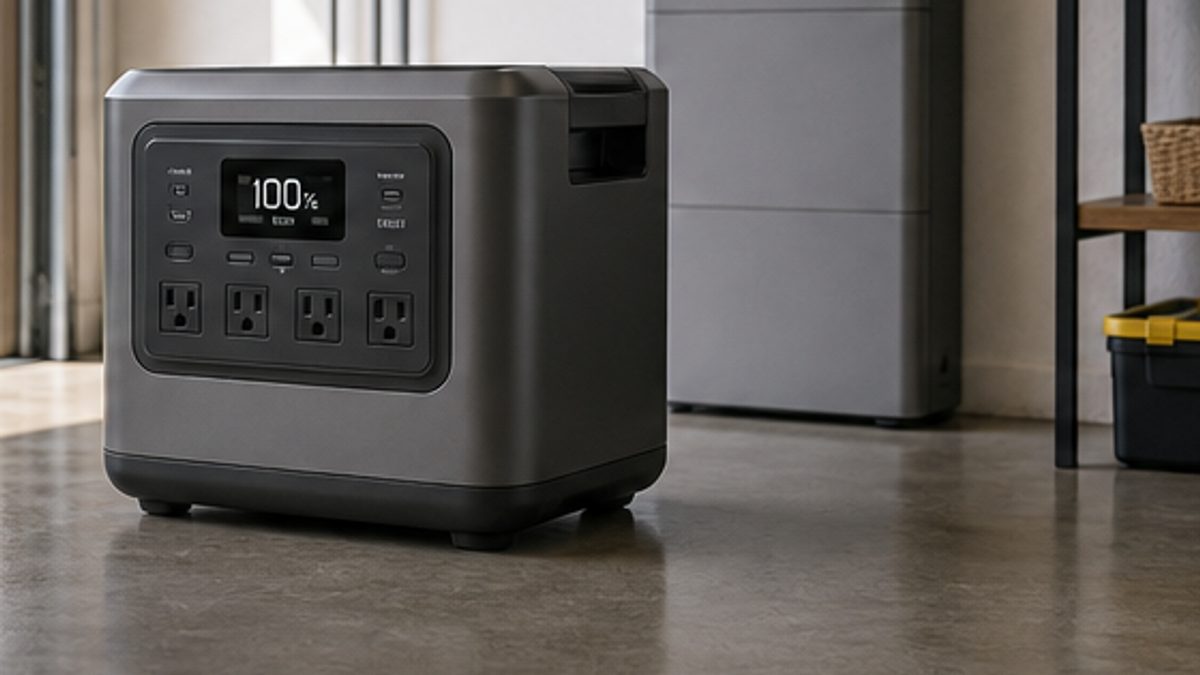
How to choose a portable power station in Canada (2026)
A checklist and the numbers that matter: rated capacity, delivered energy, inverter output, chemistry, safety certification, solar input and cold limits.

How this guide was built
Prices come from Canadian portable power and home backup retailers and are refreshed on a regular schedule. The price at the retailer is the one that counts, so confirm it before you buy.
The kits and picks in a guide are chosen by our team to match its examples, not paid placements. Specifications come from manufacturers, so check the current manual before you buy.
A portable power station is a battery, an inverter and a charge controller in one box. The spec sheets are dense and the marketing is loud, so this guide starts with a checklist, then explains the handful of numbers that let you compare models on equal footing.
The short checklist
- Size the energy you need in watt-hours from what you will run and for how long. The home backup sizing guide shows the formula.
- Size the output you need in watts from the biggest thing you will plug in, plus surge headroom for motors.
- Look for safety certification to ANSI/CAN/UL 2743 from a recognized lab, and ask for the listing.
- Check the battery chemistry and the manufacturer's stated cycle life and warranty.
- Check solar input limits (volts, amps and watts) if you will charge from panels. They are fixed in hardware.
- Check the cold-weather charging range if the unit will live in a garage, cabin or vehicle.
- Check expandability and ecosystem lock-in if home backup is the goal.
- If you depend on medical equipment, follow the device manufacturer's guidance, not a spec sheet. See below.
Three numbers that are not the same thing
Brands print capacity and output prominently. For a fair comparison, keep three ideas apart.
Rated capacity (Wh) is the energy the battery is rated to store. It is a nameplate figure. It is not the energy you can draw as household AC.
Delivered energy (Wh) is what actually reaches your appliances after the inverter's conversion loss, and after any reserve you choose to hold back. The sizing guide plans with 15% conversion loss and a 20% reserve, which turns a rated 1,000 Wh into about 680 Wh of planning energy. For example, a steady 60 W load on a 1,000 Wh unit runs about 14 hours with the reserve spent (1,000 × 0.85 ÷ 60 ≈ 14.2) and about 11 hours holding 20% back. Efficiency varies by model, so check the manufacturer's figure.
Inverter output (W) is how much power the unit can supply at once. It answers "what can I plug in?", not "how long will it last?". A 500 W inverter will not start a microwave however large the battery is. Look at two numbers:
- Continuous output: what the unit sustains. The sum of everything running together must stay below it.
- Surge (peak) output: what it tolerates for a moment. Motors and compressors (fridges, sump pumps, power tools) briefly draw several times their running watts when they start, so surge headroom matters more than it looks.
Some brands advertise a boost or "X-Boost" style mode for resistive loads such as kettles. How it works and what it allows is model-specific; read the manufacturer's description, and do not treat it as a substitute for real surge capacity on motors.
LiFePO4 and NMC chemistry
Most current mid-size and large stations use LiFePO4 (lithium iron phosphate); some lighter and older models use NMC (lithium nickel manganese cobalt). Published cycle-life ratings vary by model, and manufacturers' spec sheets commonly rate LiFePO4 in the thousands of cycles and NMC in the hundreds to around a thousand. These are manufacturer claims, not independent measurements, so compare each model's stated cycles and the capacity it is rated to keep at that point. LiFePO4 is generally described as more thermally stable; NMC stores more energy per kilogram, which is why it persists in lighter units.
Safety certification
Look for certification to ANSI/CAN/UL 2743, the joint Canada and U.S. safety standard for portable power packs, listed by a recognized certification body (Standards Council of Canada record). A logo on a listing is not proof: ask for the certificate or find the product in the certifier's public database. Systems that are permanently wired to a building, or very large systems, are covered by other standards and by electrical code, which is also why installation is a job for a licensed electrician. Uncertified imports do appear on marketplaces, and a battery you keep in your home is not the place to gamble.
Solar input
If you will recharge off-grid, check the maximum solar input in watts, the input voltage window, and the maximum input current. They are fixed in hardware. Small stations may accept only 100 to 200 W of solar, while larger ones accept far more; always read the unit's own figures. Most use MC4 connectors through an adapter. The solar pairing guide walks through the checks and the winter-voltage trap.
UPS and EPS functions, and medical equipment
Many stations can sit between the wall and your devices, passing grid power through and switching to battery when the grid fails. Marketing calls this "UPS mode". Technically it is often an emergency power supply (EPS) function, and switchover times are model-specific figures on the spec sheet, commonly in the tens of milliseconds or less, but not necessarily instant. A true online UPS has no transfer time. If you are protecting sensitive equipment, find the stated switchover time and the manufacturer's statement about what the function is and is not intended for, instead of relying on the label.
Medical devices are a different question. A switchover time does not establish that a particular station is compatible with a particular device, and this guide does not claim that any station works with any CPAP or other medical equipment. Device manufacturers publish their own guidance: ResMed, for instance, provides battery and power converter information specific to its CPAP devices, and the right power source can differ between device models and humidifier or heated-tube settings. Check your device's manual and its manufacturer's current compatibility information, and talk to your clinician or equipment supplier about an outage plan before you depend on any setup.
Expandability
Larger stations often accept expansion batteries that add capacity without buying a second inverter. If home backup is part of the plan, an expandable unit can be cheaper than replacing a sealed one later. The catch is ecosystem lock-in: expansion batteries are brand-specific and often model-specific, so you are committing to that manufacturer for future capacity. The sizing guide covers how much capacity a household actually needs.
Cold weather
Standard lithium-ion cells should not be charged below freezing: charging a frozen cell can plate metallic lithium on the anode, which causes permanent loss of performance and safety margin (Battery University). Power stations with a battery management system may block or throttle charging in the cold, and some models include heating. Check each model's stated charging temperature range, store and charge the unit somewhere above freezing if you can, and note that discharge capacity also drops in the cold.
Buying in Canada
Prices here are in Canadian dollars, and what you pay depends on where you buy. Many brands sell directly in Canada, and large retailers carry mainstream models. Before you order, confirm the price is in CAD, who ships it and from where (a cross-border order can add duty and brokerage), what the warranty covers in Canada, and whether service is local.
Prices for this category move. Rather than guess the best moment, decide the capacity and output you need, shortlist two or three models, and track them: powerstations.ca shows each product's price history and can email you when a model reaches your target price. Confirm the price and the availability at the retailer before you buy.
Models to start from
Best options · priced live
Power station picks
BLUETTI
BLUETTI Elite 30 V2 | 288Wh 600W Portable Power Station - BLUETTI Elite 30 V2 | 288Wh 600W Portable Power StationBluetti Canada

Choose one. Prices are per option.
Sources and notes
- Safety standard: Standards Council of Canada, ANSI/CAN/UL 2743 portable power packs.
- Lithium-ion low-temperature charging: Battery University, Charging at high and low temperatures.
- Medical device power guidance: the device manufacturer. Example: ResMed, battery and power converters.
- Cycle life, efficiency, switchover time and charging range are manufacturer-stated figures that vary by model; they were not independently tested for this guide.
- The 15% conversion loss and 20% reserve are the planning assumptions used throughout our sizing guide.
See a deal you like? Set a target price.
We'll watch it at Canadian power retailers and email you when it drops.
Track a price on any product
Explore More Guides
Shop Related Deals
Get notified about new guides
We publish guides on choosing a power station, sizing home backup, and pairing solar panels. Subscribe to be told when one is added. No spam, unsubscribe anytime.
Sent by powerstations.ca · powerstations.ca