
Anker · Portable Power Stations
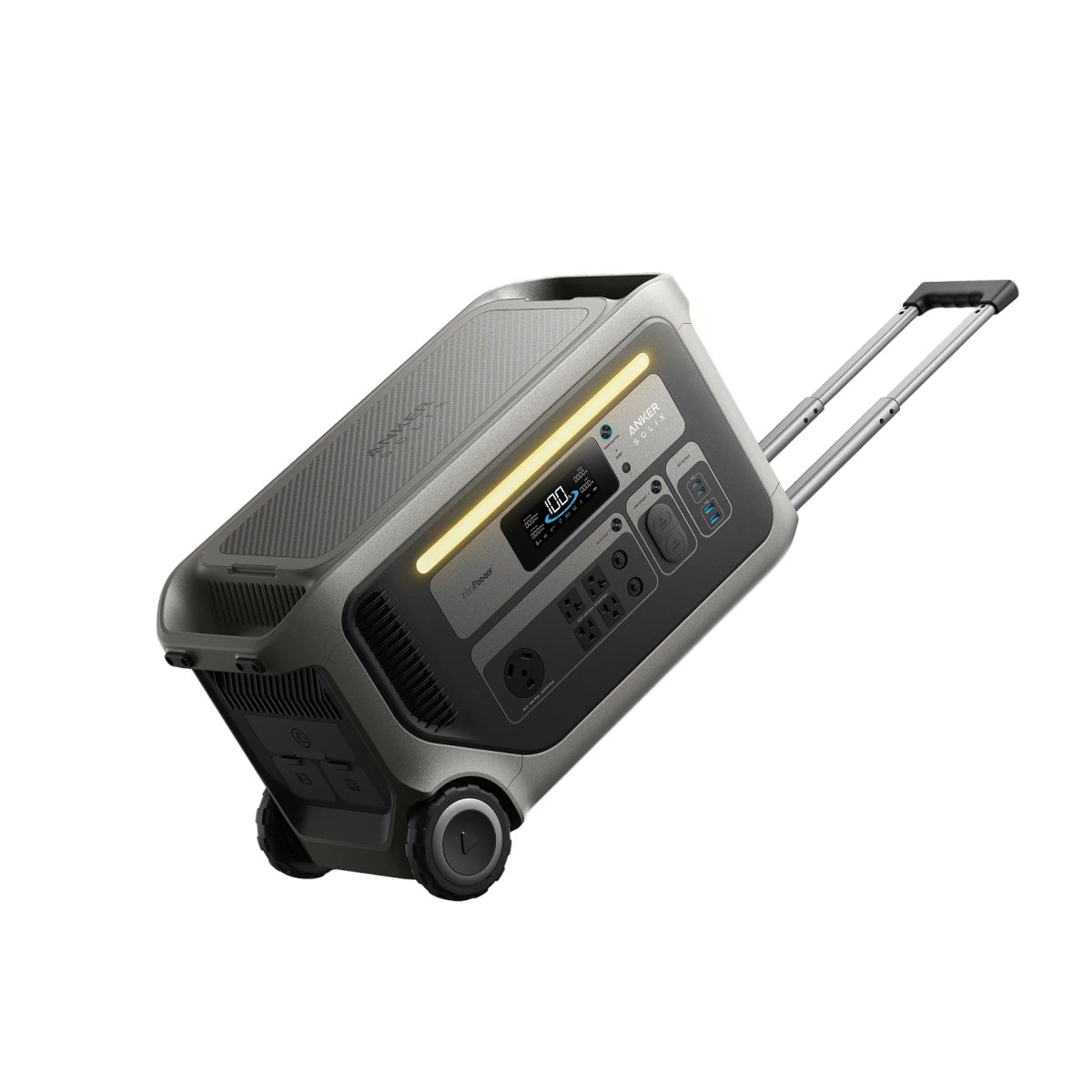
Anker SOLIX F3000 Portable Power Station - 3,072Wh | 3,600W
$1,899.00
$3,899.00Save $2,000.00 (51%)
at Anker Canada
Price checked Oct 26, 2026
Key specs
- Rated battery capacity
- 3072 Wh
- Continuous output
- 3600 W
- Surge output
- 7200 W
- LiFePO4 chemistry
- Yes
- Weight
- 41.5 kg
- Warranty
- 5 years
Example runtimes
- Refrigeratorabout 46 hours
- Freezerabout 61 hours
- Wi-Fi router and modemabout 84 hours
Assumes 85% inverter efficiency and a 20% reserve (rated Wh × 0.68). Your appliances will differ; see the sizing guide.

Key specs
- Rated battery capacity
- 3072 Wh
- Continuous output
- 3600 W
- Surge output
- 7200 W
- LiFePO4 chemistry
- Yes
- Weight
- 41.5 kg
- Warranty
- 5 years
Example runtimes
- Refrigeratorabout 46 hours
- Freezerabout 61 hours
- Wi-Fi router and modemabout 84 hours
Assumes 85% inverter efficiency and a 20% reserve (rated Wh × 0.68). Your appliances will differ; see the sizing guide.
Price tracked since Oct 25
Is this a good deal?
- The current price took effect within the last day.
- Across the 18 Portable Power Stations deals we’re tracking right now, the median discount is 36% — this deal’s 51% off is well above that mark.
Based on prices we’ve recorded from Anker Canada since October 2026, refreshed several times daily.
About this product
The Anker SOLIX F3000 is a high-capacity portable power station built around a 3,072Wh lithium iron phosphate (LFP) battery, rated for up to 4,000 charge cycles and backed by a 5-year warranty. It delivers 3,600W of continuous AC output (7,200W surge) across two AC outlets, handling most household essentials at 120V, and two units can be paired for 240V appliances without requiring an electrician. Recharging is equally capable, accepting up to 2,400W of solar input across 60V and 165V configurations for a full charge in under two hours under optimal sunlight, while AC wall charging also runs at 3,600W. Combining a fuel generator with solar can push recharge rates to 6,000W when an expansion battery is connected. Capacity scales from the base 3,072Wh up to 24kWh with compatible expansion batteries. The unit operates at a quiet 35 dB, draws very little power at idle (supporting up to 5 days of AC standby or two days powering an 8 cu.ft refrigerator), and switches to UPS mode within 20 milliseconds. USB-C Power Delivery reaches 100W, and a 12V DC output is also included. The station weighs 41.5 kg.
- Category
- Portable Power Stations
- Brand
- Anker
What people are saying
Reviewers consistently praise the Anker SOLIX F3000 for its impressive real-world power output, sturdy build quality, and versatile charging options. The LiFePO4 battery, quiet operation, clear display, and capable companion app earn frequent compliments, as does its UPS functionality with fast switchover. Users also appreciate the expandable capacity and dual solar MPPT inputs for fast recharging. The most common criticism is its weight (over 91 lbs), which makes true portability a challenge despite the included wheels and retractable handle. Some users note awkward weight distribution and difficulty navigating stairs. App connectivity issues and the high MSRP are also recurring concerns, though many reviewers recommend waiting for a sale.
Specifications
- Rated battery capacity
- 3072 Wh
- Continuous output
- 3600 W
- Surge output
- 7200 W
- Solar input (max)
- 2400 W
- AC recharge speed
- 3600 W
- LiFePO4 chemistry
- Yes
- Cycle life
- 4000 cycles
- Weight
- 41.5 kg
- UPS switchover
- 20 ms
- Expandable
- Yes
- AC outlets
- 2
- USB-C PD
- 100 W
- 12 V DC output
- Yes
- Noise
- 35 dB
- Warranty
- 5 years
Related Guides
How much backup capacity does your home actually need?
A formula and one set of stated assumptions to size home backup: daily watt-hours, conversion loss, reserve, and runtimes for 1, 2, 3.6 and 5 kWh units.
Pairing solar panels with your power station
Check voltage, current, power, polarity and connector before you connect panels, then size panel watts for Canadian sunshine with stated assumptions.
How to choose a portable power station in Canada (2026)
A checklist and the numbers that matter: rated capacity, delivered energy, inverter output, chemistry, safety certification, solar input and cold limits.
More Portable Power Stations Deals
 58%
Jackery Explorer 2000 v2 Portable Power Station
$1,099.00
 55%
Anker SOLIX F3000 + Expansion Battery
$2,999.00
 54%
Anker SOLIX C2000 Gen 2 Portable Power Station - 2,048Wh | 2,400W
$1,099.00
 48%
EcoFlow DELTA 3 Max Series Portable Power Station (2048Wh)
$1,099.00
 48%
Anker SOLIX C300 DC Portable Power Station - 288Wh (90,000mAh) | 300W
$232.99
 44%
Anker SOLIX F3800 Plus Portable Power Station
$3,299.00