
Jackery · Portable Power Stations
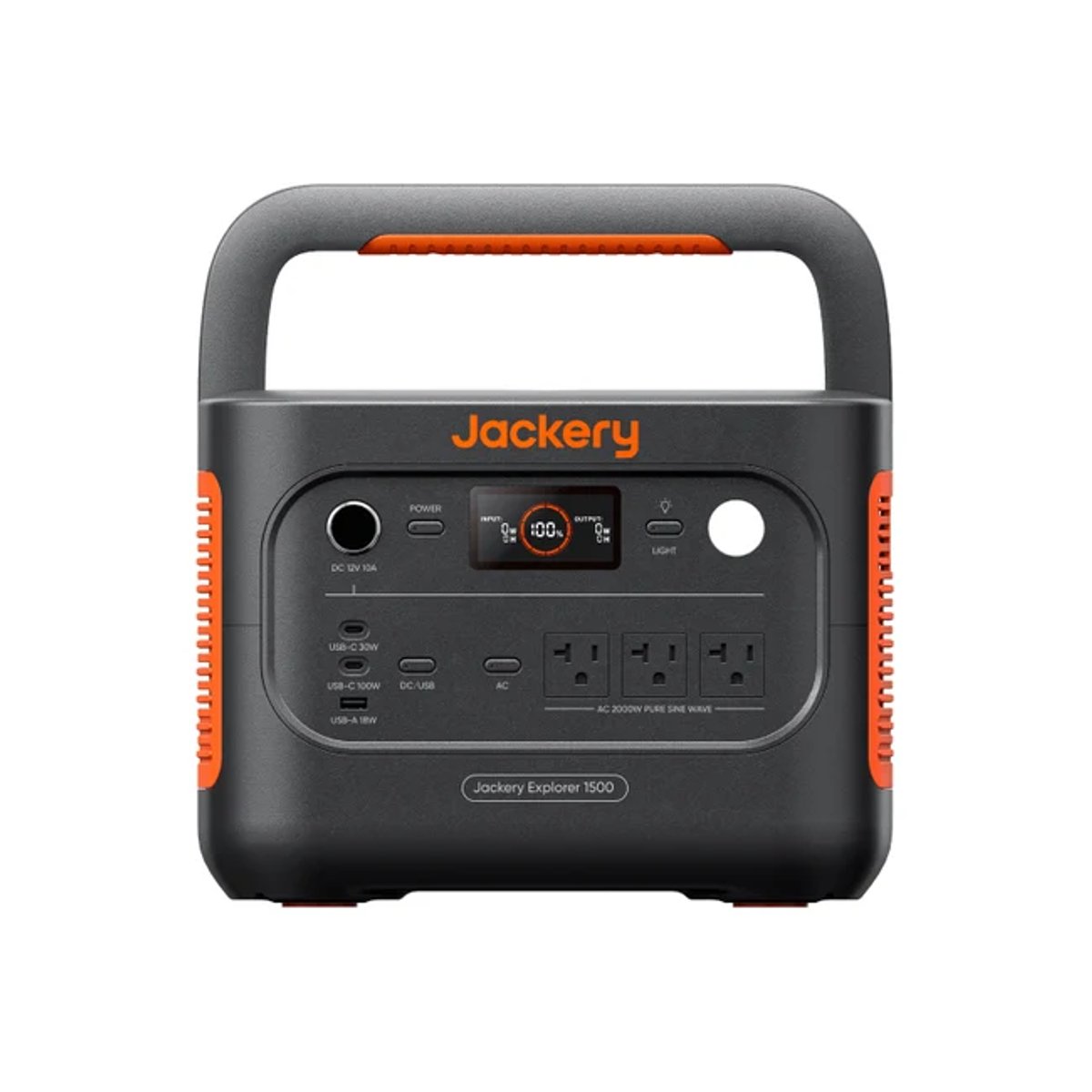
Jackery Explorer 1500 v2 Portable Power Station
$1,049.00
$1,699.00Save $650.00 (38%)
at Jackery Canada
Price checked Oct 25, 2026
Key specs
- Rated battery capacity
- 1536 Wh
- Continuous output
- 2000 W
- Surge output
- 4000 W
- Weight
- 14.5 kg
- Warranty
- 10 years
Example runtimes
- Refrigeratorabout 23 hours
- Freezerabout 31 hours
- Wi-Fi router and modemabout 42 hours
Assumes 85% inverter efficiency and a 20% reserve (rated Wh × 0.68). Your appliances will differ; see the sizing guide.

Key specs
- Rated battery capacity
- 1536 Wh
- Continuous output
- 2000 W
- Surge output
- 4000 W
- Weight
- 14.5 kg
- Warranty
- 10 years
Example runtimes
- Refrigeratorabout 23 hours
- Freezerabout 31 hours
- Wi-Fi router and modemabout 42 hours
Assumes 85% inverter efficiency and a 20% reserve (rated Wh × 0.68). Your appliances will differ; see the sizing guide.
Price tracked since Oct 25
Is this a good deal?
- The current price took effect within the last day.
- Across the 18 Portable Power Stations deals we’re tracking right now, the median discount is 36% — this deal’s 38% off is right around that mark.
Based on prices we’ve recorded from Jackery Canada since October 2026, refreshed several times daily.
About this product
The Jackery Explorer 1500 v2 is a portable power station built around a 1536Wh LiFePO4 battery cell, delivering 2000W of continuous AC output and a 4000W surge capacity suitable for high-demand appliances. Three AC outlets, dual USB-C fast-charge ports, and additional DC connections give seven ports in total, covering everything from laptops and phones to e-bikes and car fridges. At 14.5 kg, it is positioned as one of the most compact and lightweight options in the 1.5kWh class. Recharging is flexible: a combined AC plus 400W solar input brings the unit from empty to full in roughly 51 minutes, while solar alone at 400W takes about 4 hours, and a DC-DC alternator charger completes the job in approximately 3.5 hours. The LiFePO4 chemistry supports a rated cycle life of 6,000 charge cycles, and Jackery backs the unit with a 10-year warranty. More than ten onboard safety protocols provide protection for both connected devices and the unit itself, making it a practical choice for camping, RV travel, and home backup use.
- Category
- Portable Power Stations
- Brand
- Jackery
- Type
- Portable Power Station
- Car Charging
- 14.5Hrs
- Solar Charging (200w)
- 7.5Hrs
- Solar Charging (400w)
- 4Hrs
- Ac+Solar Charging(400w)
- 51 Mins
- Dc-Dc Alternator Charger
- 3.5Hrs
What people are saying
Reviewers consistently praise the Jackery Explorer 1500 v2 for its impressive fast-charging speed (around 64 minutes from wall power), its LiFePO4 battery chemistry offering long-term durability, and its strong value relative to competing 1.5kWh stations. Users highlight its versatility for camping, van life, and home backup, with particular appreciation for powering CPAP machines, fridges, and laptops. The companion app, bright LCD display, and quiet-mode charging option also earn frequent compliments. The most common criticisms center on weight (around 32 to 37 lbs depending on the source), fan noise under heavy loads or fast charging, a slower car-charging speed, and some reports of actual usable capacity falling short of the advertised figure. A handful of users also note occasional Bluetooth connectivity drops in the app.
Specifications
- Rated battery capacity
- 1536 Wh
- Continuous output
- 2000 W
- Surge output
- 4000 W
- Cycle life
- 6000 cycles
- Weight
- 14.5 kg
- Expandable
- No
- AC outlets
- 3
- Warranty
- 10 years
Related Guides
How much backup capacity does your home actually need?
A formula and one set of stated assumptions to size home backup: daily watt-hours, conversion loss, reserve, and runtimes for 1, 2, 3.6 and 5 kWh units.
Pairing solar panels with your power station
Check voltage, current, power, polarity and connector before you connect panels, then size panel watts for Canadian sunshine with stated assumptions.
How to choose a portable power station in Canada (2026)
A checklist and the numbers that matter: rated capacity, delivered energy, inverter output, chemistry, safety certification, solar input and cold limits.
More Portable Power Stations Deals
 58%
Jackery Explorer 2000 v2 Portable Power Station
$1,099.00
 55%
Anker SOLIX F3000 + Expansion Battery
$2,999.00
 54%
Anker SOLIX C2000 Gen 2 Portable Power Station - 2,048Wh | 2,400W
$1,099.00
 51%
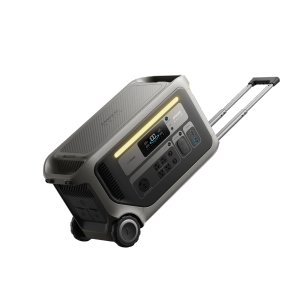
Anker SOLIX F3000 Portable Power Station - 3,072Wh | 3,600W
$1,899.00
 48%
EcoFlow DELTA 3 Max Series Portable Power Station (2048Wh)
$1,099.00
 48%
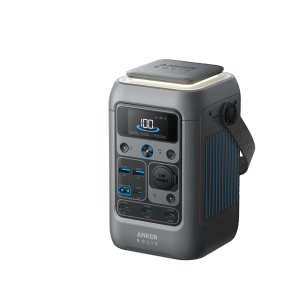
Anker SOLIX C300 DC Portable Power Station - 288Wh (90,000mAh) | 300W
$232.99